Bridge: play online for free (solo & multiplayer)
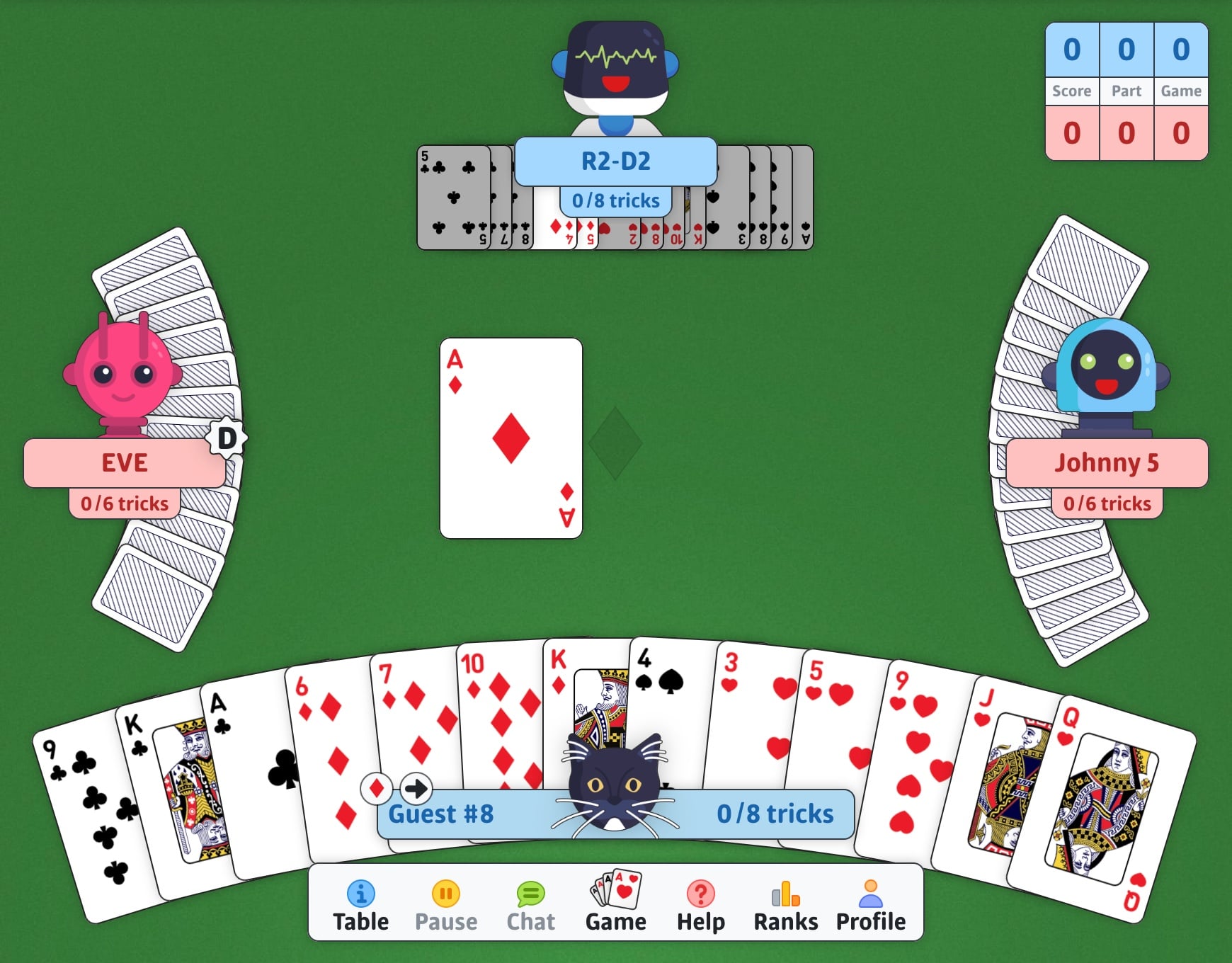
Play free Bridge online against the computer, team up with other players online, or create a private table for you and your friends. Whichever way you choose, you're sure to enjoy this legendary card game. If you have a competitive streak, you can join a ranked game to test your skills against experienced players.
Rate Bridge
Bridge is a trick-taking game played by 4 people in two partnerships, with partners sitting across from each other. Often called the "king of card games," Bridge combines strategic bidding with skillful card play. It shares ancestry with Whist and, like Spades, rewards teamwork, memory, and tactical thinking. The version played here is Rubber Bridge.
Bridge by the numbers
Real totals from every game of Bridge played on World of Card Games, updated October 2026.
- Games played here: 33,000
- Average game length: 18 minutes
- Combined playtime: 3 years
Rules
Here's enough to play your first rubber. For the complete reference and an interactive tutorial that walks you through a real game, see our guide on how to play Bridge.
Objective
You and your partner are trying to win the rubber. It ends when one partnership wins two games, and the partnership with the higher total score wins. A game is won by scoring 100 or more trick points. Part scores carry forward from deal to deal until one side gets there.
The deal and the auction
Each player gets 13 cards from a standard 52-card deck, Aces high. The dealer speaks first and the auction moves clockwise. A bid names a number from 1 to 7 plus a denomination, meaning one of the four suits or no trumps. The number is how many tricks above six your side promises to win, so a bid of 2 hearts commits you to eight tricks with hearts as trump. Each bid must outrank the last one, either with a higher number or with the same number in a higher denomination. Clubs rank lowest, then diamonds, hearts and spades, with no trumps on top.
Instead of bidding you can pass, double an opponent's bid to raise the stakes, or redouble when the opponents have doubled your side's bid. Any new bid cancels a double. Once a bid is followed by three passes, the auction ends and that bid becomes the contract. The player on the winning side who first named the contract's denomination becomes the declarer. If all four players pass right away, the hand is thrown in and the next dealer deals.
The play
The player to the declarer's left leads the first trick. Right after that lead, the declarer's partner becomes the dummy and lays their whole hand face up on the table. The declarer plays both hands for the rest of the deal. Everyone must follow suit if they can. If you can't, you may play any card, including a trump. The highest card of the led suit wins the trick unless a trump lands on it, in which case the highest trump wins. In a no trumps contract the highest card of the led suit always wins. The trick winner leads next and the deal runs through all 13 tricks.
Scoring and winning
If the declaring side takes at least as many tricks as they bid, they score trick points below the line. Only the tricks named in your bid score here, not the six that come before them. Clubs and diamonds pay 20 for each of those tricks, hearts and spades pay 30, and no trumps pays 40 for the first and 30 for each one after. So 3 no trumps made is worth exactly 100, enough for a game in one deal. Overtricks, slam bonuses, honors and doubling bonuses go above the line, where they count toward the final total but not toward game. If declarer falls short, the defenders score penalty points above the line for every undertrick. Those penalties climb when the contract was doubled or the declaring side was vulnerable. A side becomes vulnerable once it has won a game in the current rubber. The first partnership to win two games ends the rubber and takes a rubber bonus, 700 points if the other side never won a game and 500 if it won one. Then everything above and below the line is added up and the side with the higher total wins. That is usually the side with two games, but big penalties or bonuses can put the other side ahead.
How to win at Bridge
Success in Bridge comes down to bidding accurately, planning your play as declarer, and defending with your partner in mind. We've summarized the essentials for each below.
Bidding:
- Count your high-card points before you bid. An Ace is worth 4, a King 3, a Queen 2 and a Jack 1. An opening bid usually needs about 12 points or more.
- With 22 points or more, open 2 clubs. The bid says nothing about your clubs, and the bots use it the same way. If your partner opens 2 clubs, don't pass. With fewer than 8 points, bid 2 diamonds, which says nothing about diamonds either.
- Communicate your hand shape and strength to your partner through your bids. Each bid tells partner something about your hand.
- Don't overbid! It's better to make a smaller contract than to go down in an ambitious one.
- Pay attention to your opponents' bids. They reveal information about their hands too.
- Consider vulnerability when bidding. Higher penalties when vulnerable mean you should be more conservative.
- Slams pay big bonuses, but only if you bid them. Making 12 tricks in a 4 spades contract earns no slam bonus, so when partner shows real strength, think about pushing on.
Declarer play:
- Before playing a single card, count your winners and losers. Plan how you'll make your contract.
- Consider which hand to win tricks in to maintain communication between your hand and dummy.
- Draw trumps early unless you need dummy's trumps for ruffing.
- Establish your long suits to create extra winners. Small cards become good once the opponents run out of the suit.
- Use the finesse when you need to develop tricks without losing to higher cards.
Defensive play:
- Against no trumps, lead your longest and strongest suit to establish winners.
- Against suit contracts, consider leading partner's bid suit or a singleton.
- Signal to your partner with your card choices. High cards encourage, low cards discourage.
- Count declarer's tricks and work out how to defeat the contract.
Frequently asked questions
What is a trick and what is the dummy?
A trick is a round where each player plays one card. The highest card of the led suit wins it, unless someone plays a trump. The dummy is the declarer's partner. After the opening lead, dummy's cards are placed face up on the table and played by declarer.
What is a contract and how is declarer determined?
The contract is the final bid in the auction. It specifies how many tricks (above six) the declaring side must win and which suit is trump (or no trumps). The declarer is the player on the winning bidding side who first mentioned the final denomination during the auction.
What does it mean to be vulnerable?
A partnership becomes vulnerable after winning one game in the current rubber. Vulnerability increases both bonus points for making contracts and penalty points for going down.
What is a slam?
A small slam is a contract to win 12 tricks, while a grand slam is a contract to win all 13 tricks. Making slams earns large bonus points.
What is "below the line" and "above the line"?
In Rubber Bridge scoring, trick points that count toward winning a game go "below the line." Bonuses, overtricks, and penalties go "above the line." When a side accumulates 100+ points below the line, they win a game.
How do I play Bridge with friends?
Host a private table and invite your friends. Click the round yellow Play button at the table's top left to open the Play menu. Choose "Host table", turn on "Private table" and type a table name. At your new table, click "Invite players" and copy the link for your friends. Friends can also choose "Join private" in the same menu and type the same name. If only one friend can come, add a bot at each empty seat.
Can I play Bridge against the computer?
Yes. This page starts you in a game against three bots right away. Use it to practice bidding and declarer play before facing live players. For another game, click the round yellow Play button to open the Play menu and choose "New game".
Can 2 people play Bridge?
Bridge needs 4 players in two partnerships, so two people can't play it alone. You and a friend can share a private table, sit across from each other as partners and fill the other two seats with bots. Send your friend the invite link so they can pick their seat.
How long does a game of Bridge take?
About 27 minutes on average across the games played on this site. A rubber lasts until one partnership wins two games, which usually takes several deals.
Is Bridge free to play here?
Yes. Bridge is free in your browser with no download and no signup. You only need an account if you want to keep long-term stats or play ranked games.
What games are similar to Bridge?
If you enjoy Bridge, try the site's other trick-taking games, such as Pinochle, Double Deck Pinochle, Twenty-Nine, Sergeant Major and Sheepshead.