Double Deck Pinochle: play online for free (solo & multiplayer)
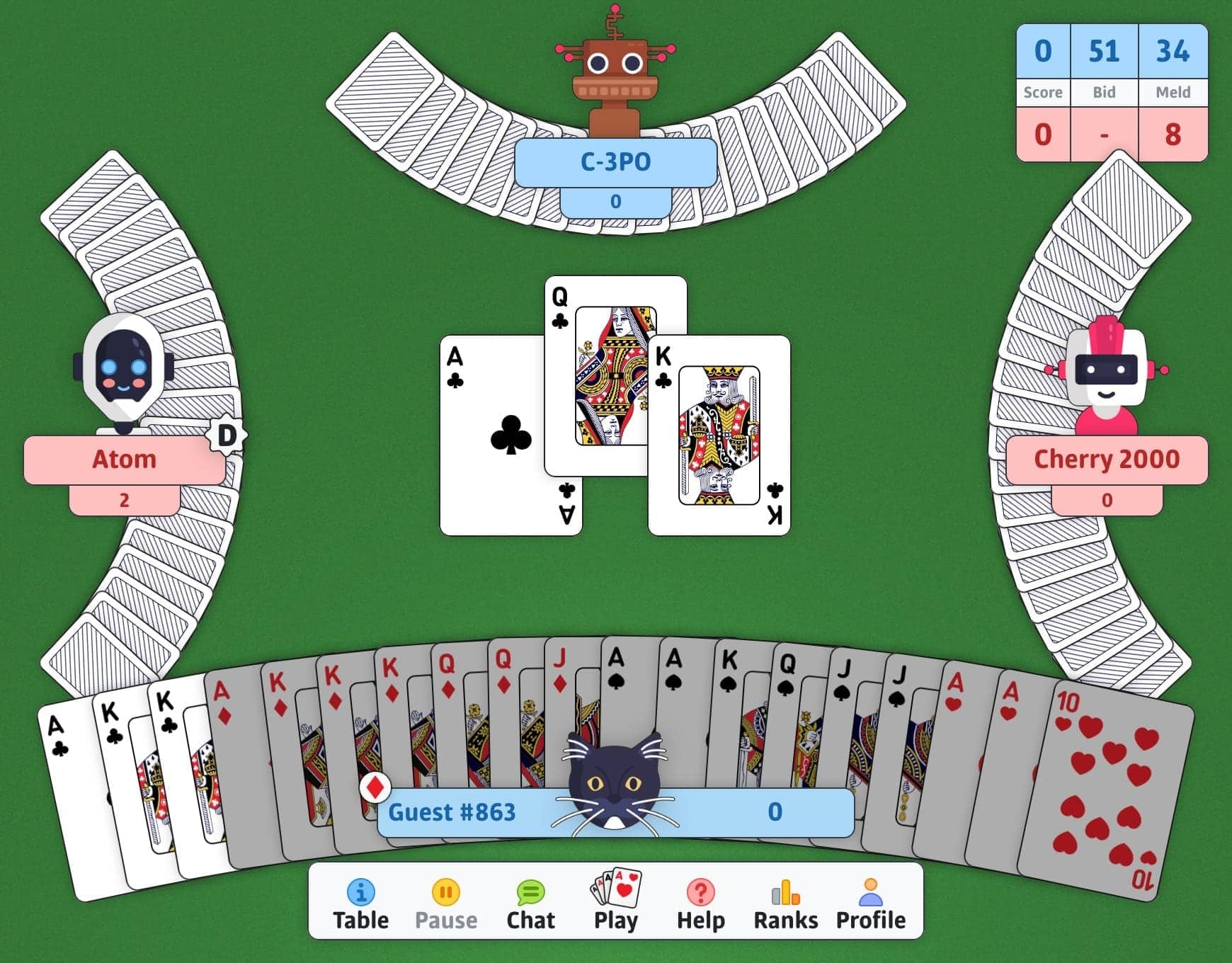
Double Deck Pinochle is a trick-taking game for 4 players in two teams of 2. It rewards strategy, memory and teamwork. Unlike Euchre or single-deck Pinochle, it's played with an 80-card deck that holds four copies of every card. Double the deck, double the fun.
Rated 4.4 by 123 players
You can play the game online for free, requiring no download or registration to get started. Play solo against the computer, join a public table to play against other people online or start your own private table and invite friends and family to play.
Double Deck Pinochle by the numbers
Real totals from every game of Double Deck Pinochle played on World of Card Games, updated October 2026.
- Games played here: 8.8 million
- Average game length: 42 minutes
- Combined playtime: 710 years
- Human players win: 43% of their finished games
Rules
Here's enough to play your first hand. For the complete reference and an interactive tutorial that walks you through a real game, see our guide on how to play Double Deck Pinochle.
Objective
Double Deck Pinochle is a partnership game for 4 players in two teams of 2, with partners sitting across from each other. Your team scores points in two ways, by showing melds and by capturing point cards in tricks. The first team to reach 500 points wins.
The deal and the bid
Each player gets 20 cards from an 80-card deck made up of four Aces, 10s, Kings, Queens and Jacks in every suit. The Ace is the highest card, followed by the 10, then the King, Queen and Jack. Starting left of the dealer, each player bids or passes. The lowest bid is 50. Bids go up by 1 until 60, then by 5. Every bid must beat the previous one. A pass is final, so a player who passes is out of the bidding for the rest of the hand. Bidding ends when 3 players have passed. A bid of 250 ends the bidding at once, since no one can top it. If nobody bids at all, the dealer is forced to bid 50. Winning the bid is a promise that your team will score at least that many points on the hand. Fall short and the bid is subtracted from your score.
Trump and meld
The bid winner names the trump suit. They may only pick a suit where they hold a marriage, a King and Queen together. If they have no marriage in any suit, the hand ends there. Their team loses the bid and the other team scores nothing. Otherwise everyone shows their meld. Melds are card patterns like marriages, runs (Ace through Jack of trumps), pinochles (Jack of Diamonds with Queen of Spades) and arounds (one card of a rank in every suit), each worth a set number of points. A team needs at least 20 meld points to score any meld at all. The "Show meld" button finds everything except runs and royal marriages for you.
The play
The bid winner leads the first trick and play moves clockwise. You must play a card of the led suit if you have one. If any of those cards can beat the highest card in the trick, you have to play one that does. This is called crawling. If you can't follow suit, you must play a trump, beating any trump already in the trick when possible. Only when you have neither may you play any card. The highest card wins the trick, with trumps beating everything else. If two identical cards are the highest, the one played first wins. The winner leads the next trick.
Scoring and winning
Each Ace, 10 and King captured in tricks is worth 1 point and the last trick is worth 2 bonus points, so the two teams' trick points always add up to 50. A team that takes fewer than 20 trick points scores nothing that hand, not even their meld. If the bidding team misses either 20-point minimum or their combined meld and trick points fall short of the bid, the bid is subtracted from their score. When their meld is so thin that even all 50 trick points wouldn't reach the bid, the hand ends right after the melds are shown, with the same penalty. Hands are played until a team reaches 500 points and wins the game. If both teams reach 500 on the same hand, the "Bidder out" option covered below decides. A team that falls to -1000 points loses the game right away.
How to win at Double Deck Pinochle
These tips come from our Double Deck Pinochle strategy guides and from real games on this site. The big skill is communication. Your bids tell your partner about your meld and your card plays signal who should take the lead.
Bidding:
- Don't bid unless you have at least one marriage. If you win the bid without one, you can't name trump and your team loses the bid on the spot.
- Use the "Show meld" button before deciding. It highlights every meld that doesn't depend on trump, so you only need to spot runs and royal marriages yourself.
- Signal your meld with your bid. Divide your trump-free meld by 10 and raise the current bid by that much, so a raise of 2 says 20 meld and a raise of 3 says 30. Never count runs or royal marriages in that number, since they depend on a trump suit nobody has chosen yet. Our meld bids guide works through full examples.
- A raise of exactly 1 or an opening bid of 50 is a captaincy bid that says "I want to choose trump". Never raise by 1 to show 10 meld because your partner will read it as a captaincy bid.
- Don't meld bid to 60 or higher, since big bids read as captaincy bids. A bid of 59 traditionally promises double Aces around, so back a computed 59 down to 58.
- If your partner has already passed, skip the signaling. Their pass told you they hold less than 20 meld and a meld bid now only informs your opponents.
- Remember your bid is a promise. If you bid 60 and only take 20 points in tricks, your team needs 40 meld points to make up the difference.
- You'll win more trick points with a relatively large number of cards in the trump suit, so weigh your trump length before fighting for the bid.
Playing:
- It's usually best to play your Aces first. It gives your partner an opportunity to feed you lower point cards.
- If your partner played a high card that is likely to win, slough your lowest-ranking point cards so the trick is worth as much as possible.
- Keep track of which cards have been played, especially the Aces and 10s. Once all Aces of a suit are gone, you may be safe leading a 10 of that suit, unless it's likely to be trumped.
- Watch for the ace-on-ace leadback. If your partner throws an Ace on the Ace you led, they're usually telling you they control that suit, so lead a low card there to hand them the lead. If you have a King in that suit, lead it, since your team will likely bank 3 points on the trick. Our ace-on-ace leadback guide shows it in action.
- A Jack played on your lead can carry the same message. Keep one Jack in a suit where you also hold an Ace so you can send the signal yourself. Feed your partner Queens rather than Jacks when you're just giving up cards. The details are in our jack leadback guide.
Frequently asked questions
What are melds in Double Deck Pinochle?
Melds are special combinations of cards, such as "pinochle" (Jack of Diamonds and Queen of Spades) or "Aces around" (an Ace in every suit), which contribute points to your team's score.
How do I signal my meld points to my partner during the bidding phase?
You can signal your meld points by carefully choosing your bid. For example, if you have 30 meld points, you can bid 3 extra points over the previous player's bid. More advanced players can develop their own bidding systems with their partners.
How do I find melds in my hand?
You can look for melds manually or use the "Show meld" button during the bidding phase to display cards involved in melds that do not require a trump suit. You will need to look for melds that do require a trump suit, such as runs and royal marriages, yourself.
What is the bidder out rule?
Bidder out decides the winner when both teams reach 500 points on the same hand by giving the win to the team that declared trump, even if the other team scored more. It's the one table option here and it's on by default. With it off, the higher score wins instead and a tie still goes to the bidding team. When you browse tables, you can see which tables have turned it off.
Can a card belong to more than one meld?
Yes, when the melds are different kinds. The Queen of Spades can count in a pinochle and in a spades marriage at the same time. Two melds of the same kind can't share a card, so a King and Queen used in a run can't also score as a royal marriage.
What is a captaincy bid?
A captaincy bid, also called a take bid, is a bid that tells your partner that you want to choose the trump suit. An opening bid of 50 or adding 1 to the previous bid usually indicates a captaincy bid.
How do I play Double Deck Pinochle with friends?
Host a private table and invite your friends. Click the round yellow Play button at the table's top left to open the Play menu. Choose "Host table", turn on "Private table" and type a table name. At your new table, click "Invite players" and copy the link for your friends. Friends can also choose "Join private" in the same menu and type the same name.
Can I play Double Deck Pinochle against the computer?
Yes. This page starts you in a game against three bots right away. Use it to practice before facing live players. The bots even read and use the jack leadback signal. For another game, click the round yellow Play button to open the Play menu and choose "New game".
Can 2 people play Double Deck Pinochle?
The game needs 4 players in two teams of 2, so two people can't play it alone. You and a friend can share a private table, sit across from each other as partners and fill the other two seats with bots. Send your friend the invite link so they can pick their seat.
How long does a game of Double Deck Pinochle take?
About 40 minutes on average across the games played on this site. Reaching 500 points usually takes several hands of bidding, melding and trick-taking.
Is Double Deck Pinochle free to play here?
Yes. Double Deck Pinochle is free in your browser with no download and no signup. An account is only needed for long-term stats and ranked games.
What games are similar to Double Deck Pinochle?
If you enjoy Double Deck Pinochle, try the site's other trick-taking games, such as Twenty-Nine, Sergeant Major, Sheepshead, Hearts and Spades.