Meld bids in Double Deck Pinochle
If you don't know about meld and trump in Pinochle yet, read up on them before you continue here.
In Double Deck Pinochle, there's a round of bidding right after the cards are dealt. As a beginner, your first task is to look at your cards and decide what to bid. This page will help with that.
If you play Spades, note that your bid in Double Deck Pinochle is not the number of tricks you think you can take.
In Double Deck Pinochle, your bid is a signal to your partner. It can tell them about your meld or about your wish to "make trump" (a jargon term that means you want to choose the trump suit).
The captaincy bid
A "captaincy bid", also called a "take bid", tells your partner that you want to choose the trump suit. The simplest one is an opening bid of 50. That's the lowest bid you can make without passing. A bid of 50 means "I want to make trump. Let me know if you have any meld." (There's one exception, the "save" bid, which I don't cover here.)
A bid that adds 1 to the previous bid is also usually a captaincy bid. For example, if the previous player bid 55 and you bid 56, you're saying "I want to make trump."
If your partner made a captaincy bid before your turn to bid, they may still find it useful to know your meld for their follow-up bids. It's also useful to give your partner a meld bid even before they have bid.
Your partner may think they have a good trump suit, but if they're poor in meld, they may be afraid to try to win the bid. The rules of Double Deck Pinochle say the team that wins the bid needs at least 20 meld. If you or your partner wins the bid but your team has 19 meld or less, the hand ends right there and you lose the points you bid! So giving your partner information about your hand is usually helpful. If you pass at your first chance to bid, that sends your partner a message too. It says "I have less than 20 meld".
Meld bid in first seat
Let's look at an example. You've been dealt your cards. As a beginner you're not sure what meld you have, so you click the "Show meld" button. You have 22 meld. The meld is counted without a trump suit, because trump hasn't been chosen yet.
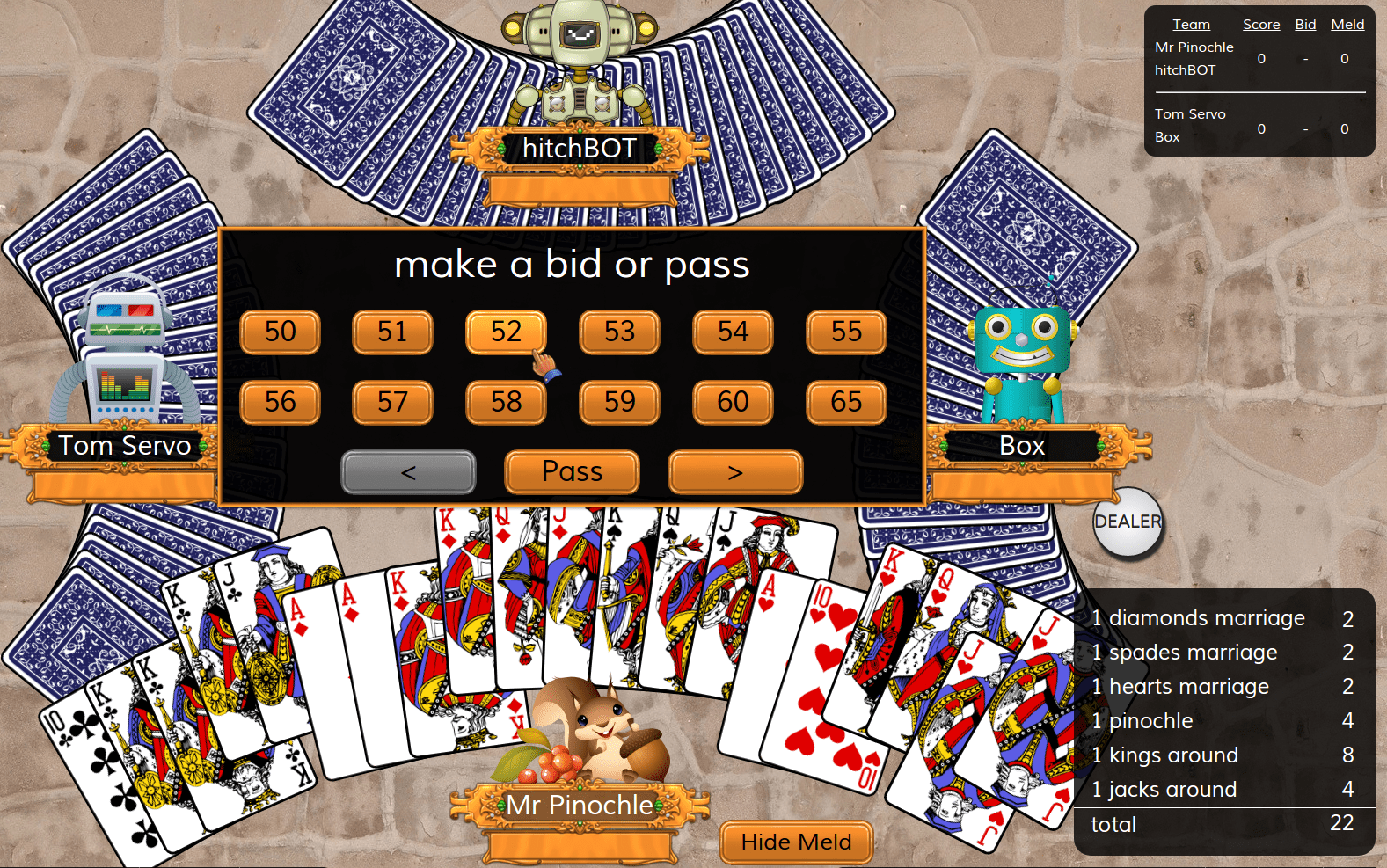
You're in "first seat". This is another jargon term. It means you're the player to the dealer's left, so you're the first to bid. What should you bid?
Let's say you want to "tell" your partner that you have 20 meld. The way to do this is to add 2 to the current bid. But there's no current bid, so what does that mean? The minimum bid is 50. So add 2 to 50 and give a "meld bid" of 52. Any player who knows about meld bids will understand that your hand has about 20 meld. That includes your opponents! You're giving your partner information, but you're giving it to your opponents as well.
You may have noticed that Mr Pinochle has a "run" in hearts in the screenshot above. He has a card of each rank in that suit (A-10-K-Q-J). If hearts were trump, he would get extra meld for the run. But never add that extra meld to your meld bid. Only count meld that doesn't depend on the trump suit.
General rules of meld bidding
Are you wondering why you added 2 to the current bid above? It's because you had 20 meld. The rule for giving a meld bid is:
- Divide your hand's meld by 10 and add the result to the current bid.
- Exception 1: Do not give a meld bid of +1. It will confuse your partner, because a +1 bid means "I want to make trump" in Pinochle! So if you only have 10 meld, don't give a meld bid at all.
- Exception 2: Don't give a meld bid if it would make your bid 60 or more. Bids of 60 or more are usually captaincy bids, not meld bids. There's an exception to this exception, called a jump bid, but it's more advanced than this page. If you have a lot of meld and a true meld bid would put the bid at 60 or more, it can still help to bid up to 58 if you can. That tells your partner you do have some meld to contribute. For example, suppose the current bid is 54 and you have 90 meld. Adding 9 to the bid would put you at 63, which isn't a meld bid. But a bid of 58 can say "I have a lot of meld."
- Exception 3: A bid of 59 often means "I have double Aces around". So if your meld bid works out to 59, you'll probably want to drop it to 58. If you do have double Aces around, bid 59 to signal it.
Meld bid in second seat
Here's an example where you're in "second seat" (second to bid). You have 52 meld, which is a lot!
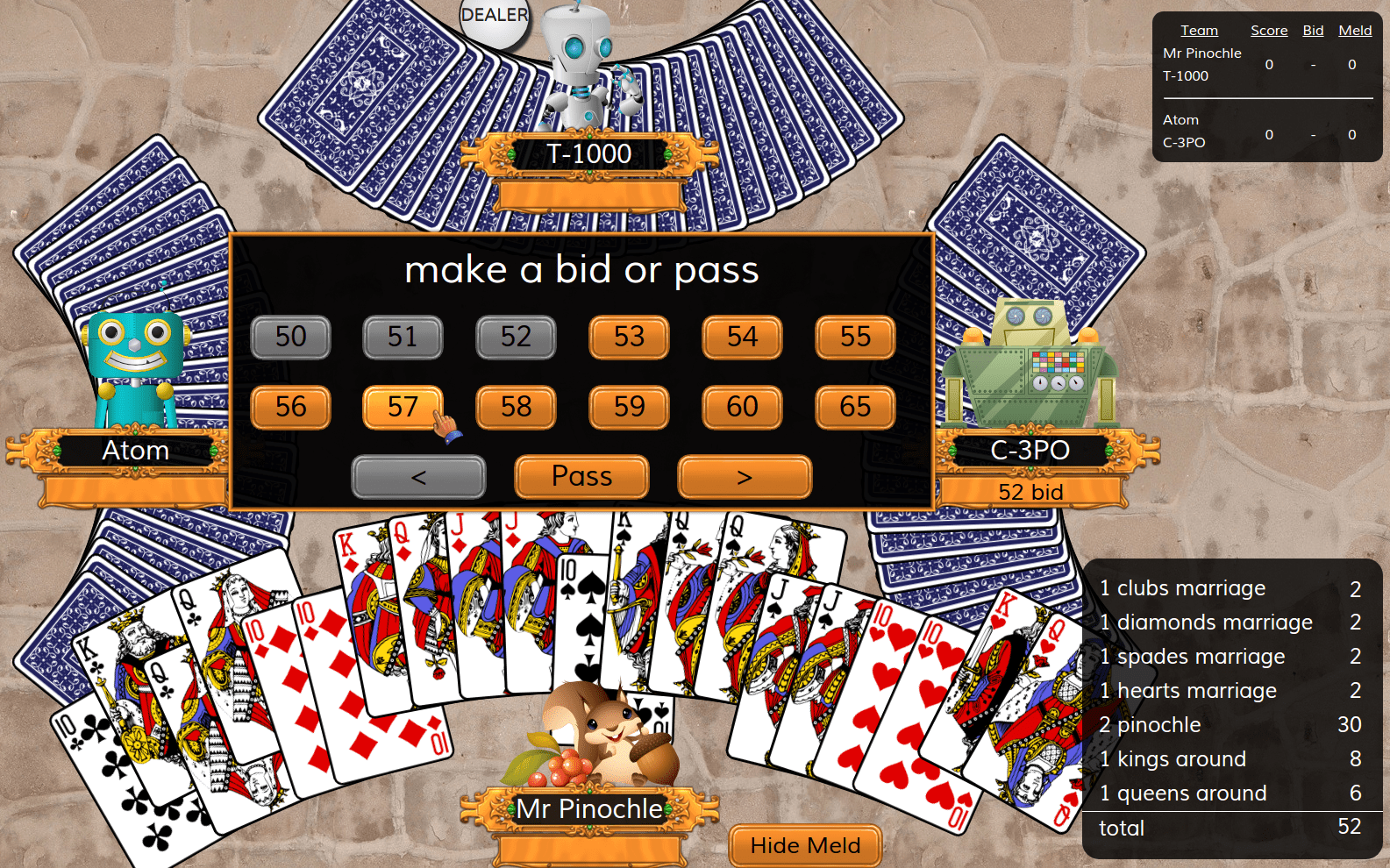
If your right-hand opponent (C-3PO in the screenshot) had passed, your meld bid would be 55. But that player bid 52, which revealed that he has about 20 meld. To give a meld bid, add 5 (52/10) to the previous bid. That means your bid should be 57. In discussions, people sometimes say "Your meld bid is +5" in this case. But never say this out loud at a Pinochle table! In Pinochle, you never signal out loud.
When is it impossible to meld bid?
In the screenshot below, Mr Pinochle shouldn't give a meld bid. There are a couple of reasons. Can you spot them?
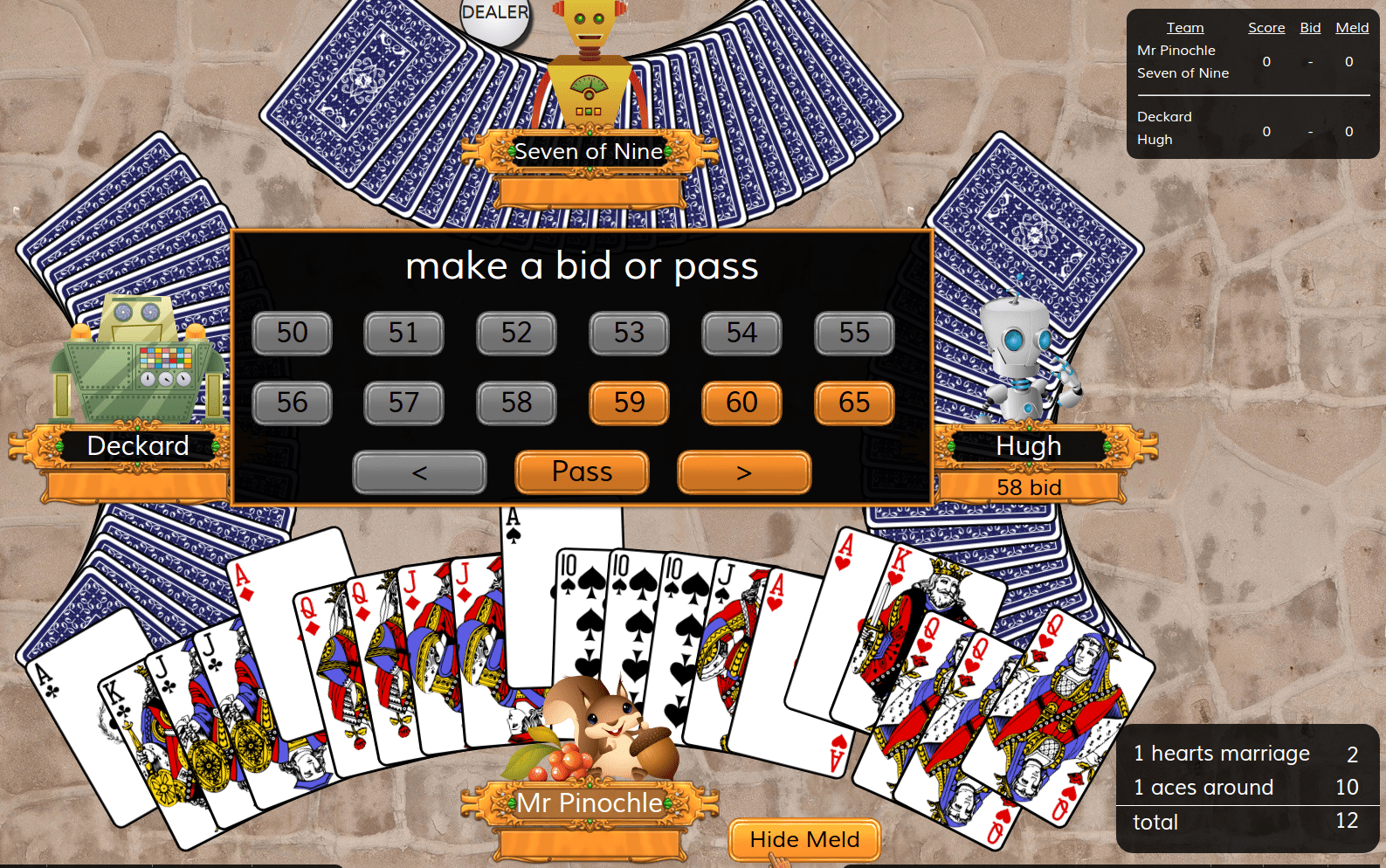
Here are the reasons. First, he doesn't have at least 20 meld. He only has 12. Adding 1 to the current bid isn't a meld bid. Second, even if he did have 20 meld, adding 2 to the current bid would push the bid to 60. Remember exception 2, which says not to give a meld bid if it pushes the bidding to 60.
Resources
You can read more about bidding here: